

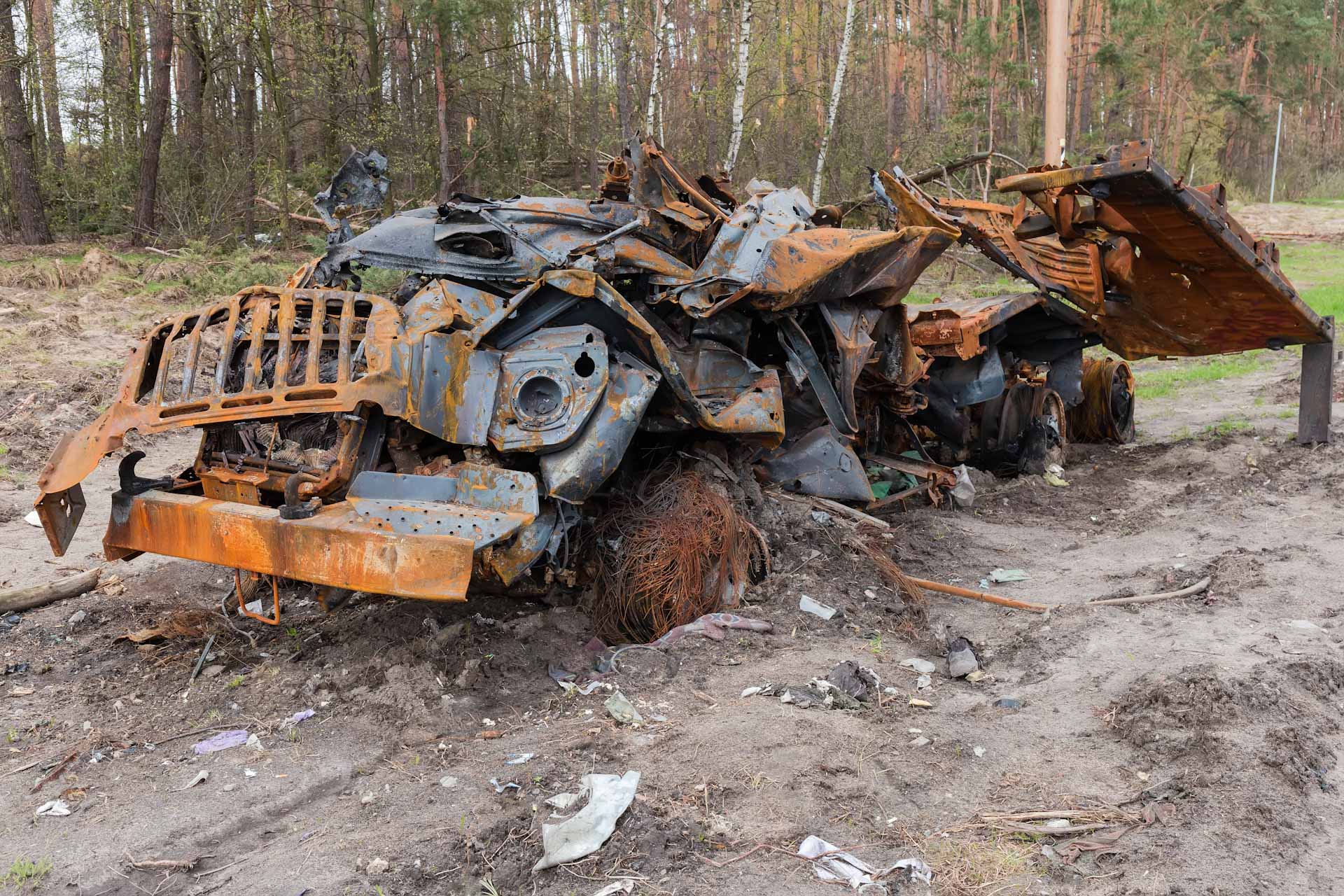
To paraphrase Thomas Hobbes, noted 17th century British philosopher – at the frontline today, the life of a Russian logistician is continual fear, and danger of violent death; and the life of Russian occupiers, solitary, poor, nasty, brutish, and short.
Today, we can see end of the beginning for Russia in Ukraine.
How did this come about?
The last quarter
Since my last article, published here in March, almost everything in the Russia – Ukraine war has gone in Ukraine’s favour.
By mid-April, one of few leaders in Europe with a consistent anti-Ukrainian outlook, Hungary’s Victor Orbán, was defeated at the ballot box. By the end of the month the European Council had finalised the key piece of legislation for a €90 billion EU loan to Ukraine. The loan covers Ukraine’s most “urgent budgetary and defence industrial capacity needs in 2026 and 2027”, of which €60 billion will go straight to Ukraine’s capacity to invest in “defence industrial capacities, including procurement of defence products.”[1]
Almost a month later, at the end of May, President Zelenskyy met with Swedish Prime Minister Ulf Kristersson in Sweden who announced the donation of up to sixteen JAS Gripen C/Ds to Ukraine. The first deliveries are expected early 2027, with Ukraine initially intending to purchase twenty of the more advanced Gripen E/F versions, with the long-term goal of acquiring between 100 – 150.[2]
As I already noted in November 2022, the same month, Justin Bronk, Nick Reynolds and Jack Watling argued in a RUSI report that “the Swedish Saab Gripen C/D offers by far the most suitable candidate in terms of operational requirement…” The fighters relative ease of maintenance, the use of dispersed bases, the electronics warfare suite, its ability to fire the very long-range Meteor missile were other reasons given for the preference.[3]
This is welcome news, and about time.
May also saw Russia occupy an additional fourteen square kilometres – the slowest rate of advance since October 2023. If Ukrainian updates were included, which for security reasons they often are not, Russia lost territory it occupies.[4]
On June 11th, another historic but horrific milestone was reached. The war has now lasted longer than World War One. According the Ukrainian ministry of defence figures (which are comparable to those regularly given by the UK and US), Russia has lost (killed or wounded), close to 1.38 million men since February 2022.[5] The recent Russian offensive at Pokrovsk advanced at an average pace of seventy-five yards (less than 70 metres) a day.[6]
“What is happening is that Russia is losing”
Before we attempt to analyse the current situation at the front, and the political ramifications of the ongoing war, it is worth revisiting earlier claims by Timothy Snyder. In July of 2022 Timothy Snyder wrote an article simply titled “The State of the Russo-Ukrainian War”. At the time, the Russian withdraw from Kyiv Oblast was only three months old, and the liberation of Kherson three months away. Yet, Snyder asserted that “what is happening is that Russia is losing.”[7]
Snyder notes, perhaps prophetically, “the war only ends when Putin realizes that Russia is losing it, in the precise sense that he realizes that his personal position is threatened.” Defeat for Russia argues Snyder, is not about territory lost or gained, but rather Ukrainian momentum that changes the mood within Russia and “creates visible tension within the Russian state, thereby forcing Putin to change his story.”
Having claimed that “it is most likely that Ukraine will win the war, Snyder lists seven underlying factors on which wars tend to be decided – “time, economics, logistics, landscape, mode of combat, ethos, and strategy (the TELLMES).”[8]
Based on these factors, why did Snyder believe Ukraine is most likely to win the war?
The arguments presented by Snyder in the summer of 2022 can be summarised as follows:
Time: Russia thought they would achieve a quick victory. They did not. The longer a war continues, the more advantages a large power has will dissipate.
Economics: Although the Russian economy is larger than Ukraine’s, Ukraine is supported by western powers and imposed sanctions on the Russian economy will bite.
Logistics: Ukraine is fighting on home turf, which is advantageous, while Russian logistics were a disaster at the beginning of the war. Though Russia now has a land corridor along southern Ukraine and can attack southern Ukraine through Crimea and the Black Sea, these connections can be broken with the right weapons.
Landscape: despite favourable terrain in southeastern Ukraine, Russia has been unable to take advantage – and soon Ukraine will have access to western weapons.
Mode of Combat: if the Russians advantage in artillery disappears, the war changes character, and if Ukraine can access the right kinds of long-range weapons, Ukraine can in a position to dictate the mode of combat. If Ukraine gains an advantage in artillery, we may see slow Russian retreats as commanders find themselves unable to rally troops for close combat.
Ethos: Russians in the field do not seem to know what they are fighting for, and the Russian leadership and people do not seem to care about them. Ukrainian soldiers know what they fight for. This matters.
Strategy: The initial premise for the Russian invasion rested on faulty premises, the official line of “denazification and demilitarisation” means the murder and humiliation of countless people Russia associates with the Ukrainian nation yet does not explain how the war will end. Most of the territory Russia now occupies was taken in the first four weeks of the war. The Russian plan seems to be to “destroy the Ukrainian economy, to terrorize civilians with missile attacks on cities, to cut energy supplies to Europeans, and to starve Africans and Asians by blockading food exports, and hope that somehow all of the suffering lines up in Russia’s favor.” The Ukrainian plan appears to be to protect the physical and social existence of Ukraine. Ukrainian goals seem more coherent.
Since then…
It is worth repeating – this was written in the summer of 2022. Four long years later, much of what Snyder wrote rings true.
On the reasons he lists, we can conclude with hindsight that he was correct about much.
On the time factor, the war is still ongoing. And the longer the war has dragged on, the worse the situation has grown for Russia. Though smaller tactical victories have been achieved since the summer of 2022, on a macro-level, Russia is suffering on many fronts (more on this later).
With regards to economics, we can conclude that Russia is suffering, and has been for some time. Already in 2023 I wrote about the deteriorating Russian economy, and in particular in the energy sector. By 2023 sanctions had started to affect Russian households. In 2024 I highlighted the shrinking workforce, inflation and the increasing cost of living. The same year I noted that defence spending was seven per cent of Russia’s GDP and 41 per cent of the state budget. Nothing in the economic sector has since improved for Russia. Equally bad for Russia and its economy is the declining population and demographic difficulties it stands before. Labour shortages are immediate in almost all sectors of the economy, and according to Harley Balzer, writing for the Atlantic Council in 2024, “We can conclude that Putin has turned a daunting crisis into a cataclysm.”[9] Since then, tens of thousands more Russians have died in Ukraine.
On the logistics side of the war, Snyder pointed out that Ukraine could break the land corridor between Crimea and mainland Russia with the right weapons. Since 2022 the rapid development and proliferation of drones has allowed Ukraine to his Russian troops and equipment at an unprecedented scale. Recent advancements have allowed Ukraine to attack high value targets, in particular in the Energy sector, deep in Russia. The Ukrainian development of cheap guided mass munitions is currently wreaking havoc in the Russian lines.
Despite trying for years to break through Ukrainian defences, the little progress that has been made has been slow and cost Russian men and equipment dearly. Irrespective of the landscape in Ukraine, Russia has not been able to advance without substantial cost.
When discussing mode of combat, Snyder wrote that if the Russian advantage in artillery disappears, Ukraine can change how the war is fought. Today, it is not artillery, but rather drones that dictate tactics and victories to a large extent. At the moment, Ukraine is firmly in an advantageous position.
It did not take long until after the invasion for videos of Russian soldiers being abused by their own commanders. A cursory search online will render countless videos of Russians being abused at the hands of their own. The Russian ethos is as bad, if not worse, than four years ago. Many of the then professional soldiers are forever buried in Ukraine, the somewhat professional PMC Wagner in ruins, and Russian morale is worse than when the war began. For Ukraine, the inverse is true. Though there is a general manpower shortage, the factors listed by Snyder still stands. Ukraine and Ukrainians know it is an existential fight, and fight as such.
Lastly, from a strategic position, it appears that the Russian maximalist goals of the initial invasion have not changed. As late as the end of April “Security Council Deputy Chairperson Dmitry Medvedev emphasised Russia’s commitment to its war aims in Ukraine and claimed that Russia is in an existential conflict with the West…”[10]
For Ukraine, the goals too remain the same. Survive, and repel the Russian invader. In the fifth year of the war, Ukraine still stands.
Taken together, the factors listed by Snyder are still relevant and reasonable metrics to evaluate the state of the war.
On the state of things
In analysing the factors as a whole, what do we find?
The factors discussed by Snyder are inescapably linked. In particular, I wish to highlight the interlinking importance of the economical, logistical and mode of combat (the way in which the war is fought) factors. Overarching this is the strategic factor. Where Russia has consistently underperformed expectations, Ukraine has more than exceeded them.
Michael Kimmage and Hanna Notte, writing in Foreign Affairs, noted that after four years of fighting, Ukraine still controls eighty per cent of its territory, Putin has overestimated what Russian hard power alone can do, and though “the year 2025 was a bad one for Russia, and 2026 may be even worse.”[11]
Moreover, despite being a nuclear power Russia has not managed to use this leverage to force Ukraine to submit. As Rebecca Lissner and John Kawika Warden correctly point out earlier this year in Foreign Affairs, Ukraine “has denied Russia its primary war aims… repelled Russia’s initial invasion, has maintained its sovereign independence, and has inflicted enormous losses on Russian forces… Kyiv has not capitulated to Moscow’s threats and has gradually escalated its own operations… launched strikes on targets inside Russia that many analysts once viewed as likely nuclear redlines, including attacks on oil and gas infrastructure, logistics hubs, the Kerch Strait Bridge connecting Crimea to mainland Russia, and even Russia’s nuclear-capable strategic bomber fleet.”[12]
Published in February 2026, the article does mention Ukrainian strikes on Russian infrastructure. Since the publication, Ukrainian strikes within Russia have increased greatly. This is important, as it pertains to the economical, logistical and mode of combat factors which Snyder discussed four years.
The Ukrainian Campaign
By June 1st, the Institute for the Study of War (ISW) claimed that Ukraine has “largely halted the Russian Spring-Summer 2026 offensive so far, and Russian forces in May 2026 have gained a presence in only a fraction of the territory they did in May 2025.”[13]
A week earlier, in late May, the ISW released a special report on the Ukrainian intermediate-range strike campaign against Russia. The report is grim reading for those who cling to the notion that Ukraine has no cards left, or that a negotiated settlement in which Ukraine is forced to concede large parts of the country is the only realistic end to the war.
The ISW writes that “Open data on Russia’s battlefield performance indicates that the character of the war is shifting in favour of Ukrainian forces, at least for now.”[14]
The mode of war is changing in Ukraine’s favour.
This is due in part to the Ukrainian campaign of suppression and destruction of enemy air defences (SEAD / DEAD), which has taken place since the end of 2025. The campaign has enabled Ukraine to “target other valuable assets in the Russian rear, enhancing the reach of Ukraine’s mid-range strike campaign, enabling Ukrainian forces to launch a higher volume of drones and larger drones deeper into airspace over Russian-controlled terrain.”[15]
The result has been a Ukrainian spring and summer campaign in which the Ukrainian armed forces have “significantly intensified its intermediate-range strike campaign against dynamic targets in Spring 2026 in order to degrade Russian logistics at operational depths ahead of a planned Ukrainian manoeuver.” By May Ukraine had begun to interdict key Russian ground lines of communication (GLOCs) in occupied Donetsk, Zaporizhia, and Kherson oblasts…”
Two days after the release of the report, Mykhailo Fedorov, the Ukrainian Minister of Defence, wrote on X (formerly Twitter), that Ukraine was launching a “logistics lockdown” on the Russian army, aiming to “systematically destroy enemy logistics and supply lines, stripping them of their capacity to launch offensive actions.”[16]
Since then, Ukraine has destroyed hundreds of vehicles and fuel tanks along Russian supply lines – every day.[17]
Jakub Janovsky concludes that the Ukrainian SEAD / DEAD efforts appear to have been a success, and the targeting of Russian logistics had by the beginning of June to already begun to “complicate” life for the Russian army.[18]
Simultaneously, Ukraine is destroying the Russian energy sector. On June 8th Steve Rosenberg of the BBC showed Russian newspapers writing that “In many regions there are restrictions on the sale of petrol…”[19]
June 16th saw footage emerge from Moscow where the Moscow Oil Refinery, which supplies around forty per cent of the city’s fuel, was hit by multiple Ukrainian drones.[20]
The same day saw the ISW report that “Russian authorities and energy companies are increasingly restricting the sale of gasoline and diesel in Russia as Ukraine’s long-range strikes against Russian oil infrastructure cause shortages.”[21]
Two days later, on the 18th, the refinery was hit again. President Volodymyr Zelenskyy made the point on X by writing that “our long-range sanctions once again reached the Moscow region – for the second time this week.”[22]
By June 19th, the ISW reported that Ukraine’s “intermediate- and long-range strike campaign against Russian fuel infrastructure continues to strain gasoline supplies.”[23]
As this is taking place, Ukraine has “continued to systematically strike bridges and other transport infrastructure supporting Russian ground lines of communication (GLOCs) that connect occupied Kherson Oblast with Crimea… Ukrainian forces continued to strike Russian oil, gas, and energy infrastructure in occupied Crimea and Russia overnight on June 19 and 20.”[24]
By the third week in June, the illegal Russian governor of Crimea announced that fuel “will only be sold to government services that ensure vital services and safety.”[25]
On June 21st Ukrainian Army Media reported that a joint operation had struck the Russian air defences around Kerch bridge –striking two pantsir air defence systems, as well as four S-400 radar stations. The bridge now sits, according to Ukraine, unprotected.[26]
Conclusion
Let us now once again return to Snyder and his prediction that Ukraine will win. As I have argued, the economical, logistical and mode of combat (the way in which the war is fought) now all seemingly favour Ukraine. Strategically, the one option Russia has perhaps left is mass mobilisation. But is Putin prepared for the political cost of mobilising men in Moscow and St Petersburg? The Russian economy is in shambles and deteriorating. What options does Russia have left?
Ukraine is pounding Russian logistics and energy sector, and the character of war is changing in Ukraine’s favour. Increasingly isolated, without any immediate remedy to alleviate the current attacks from Ukraine on their infrastructure and energy, and with little hope of successful offensive action, from a Russian perspective, there is little do be done about Crimea.
As things stand, Snyders prediction rings true. Currently, the only question becomes when, not if, Ukraine is able to recapture Crimea and break the land bridge Russia is currently occupying. There have been many twist and turns during the past four years during the war, and wars are of course unpredictable. But today is perhaps the first time in many years, when we can finally see end of the beginning for Russia in Ukraine.