

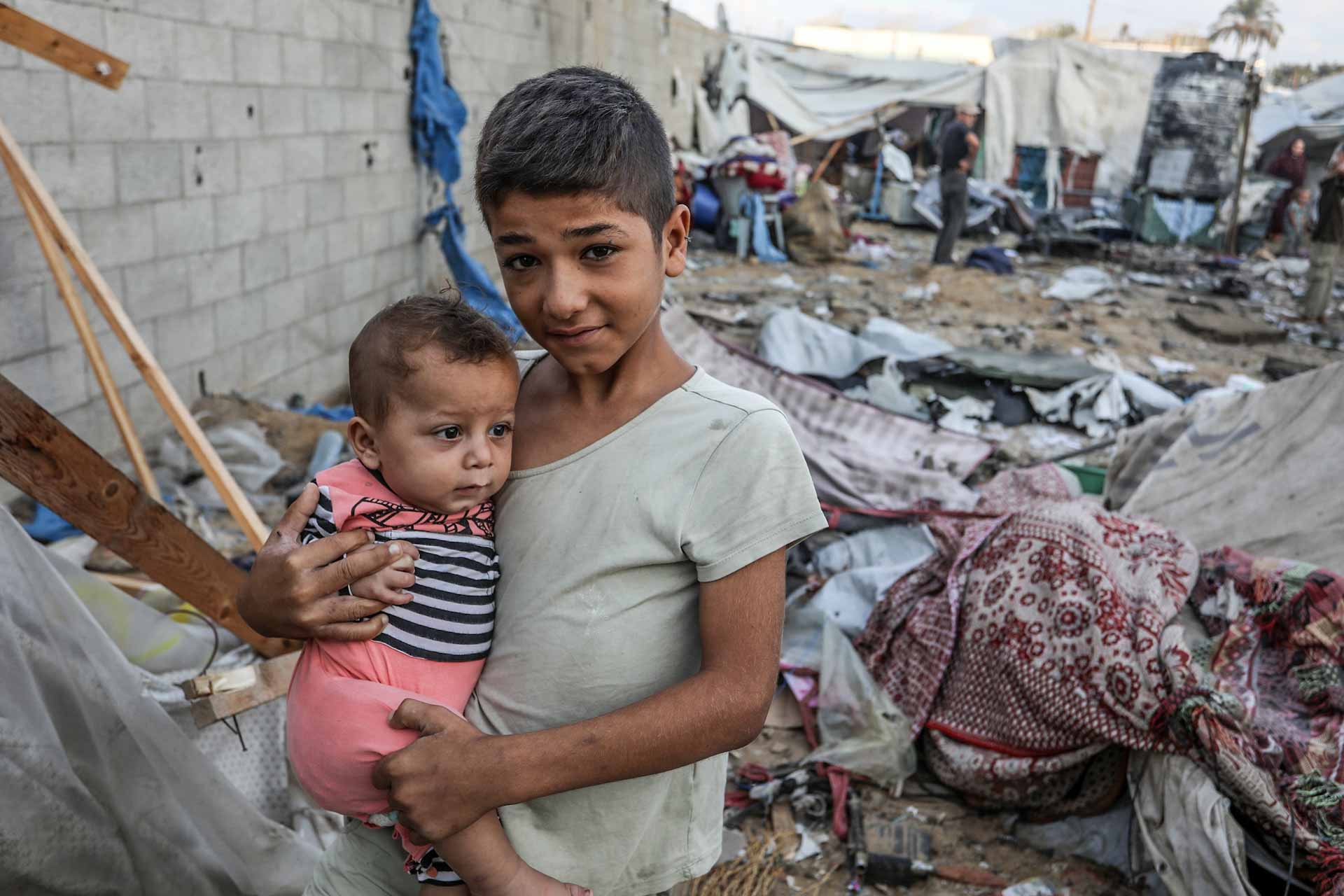
2 years after Hamas initialed its brutal surprise attack, October 7 2023, and Israel launched its retaliation campaign with many names, the world is holding its breath in anticipation of “final” negotiations being held on the tip of the Sinai peninsula, Egypt, with the presence of all relevant actors, at relevantly high level, US, Qatar, Egypt and then of course the parties themselves, Israel and Hamas. Could there finally be something worth the denomination of peace now, very soon, or could there be a huge disappointment, once again?
Obviously, there are many hopefuls, albeit for very differing reasons. Hamas representatives are hoping to survive the two years of struggle with some minimum physical and political existence intact. Palestinian civilians in Gaza are hoping finally to be relieved of the 2 years of nightmare, hoping to survive (from bombings and starvation exposure) for the few more days the warfare may still last. And the families of the 20 odd hostages that have managed to remain alive – and those that have succumbed to the extreme suffering as hostages but still be recoverable – hope to have their loved ones back after two years of agony. And Donald Trump, perhaps bearing in mind that this week is also the week of the Norwegian Noble price award announcement, hopes for a moment of triumph. To mention a sample.
So why this list of hopefuls – that finally there could be on the near-horizon the end of this terrible war that has cast so many so much – in fact much more per capita and time that any other, comparable and contemporary scene of humanitarian disaster, be it Ukraine, Syria, Yemen or Sudan?
Trump’s plan, the hopeful versus the disillusioned
Clearly, the chief architect of the recent chain of events of Donald Trump, the only global figure with the power to contain Benjamin Netanyahu, should he choose to. Contain in this case refers to denying Netanyahu and his unruly coalition the greenlight to keep avoiding a compromise outcome, instead relentlessly going for a “total victory” in pursuance of the ongoing campaign in Gaza City. “Should he choose to” refers to the protracted question of whether there is, or is not, a limit somewhere, at some stage, to the Trump support rendered to Netanyahu in his battle against his perceived mortal enemies. The answer seemed last Friday evening – upon expiry of Trump’s ultimatum to Hamas – to be given as Trump swiftly responded to Hamas´ first response the ultimatum, Trump announcing that the Israeli bombings must cease “immediately” in response to Hamas’ partial answer declaring willingness to release all hostages (in exchange for a certain quantity of Palestinian prisoners) and to accept in principle the notion of a future Gaza being ruled by a “technocratic” Palestinian rulership (of sorts). I.e., some huge steps towards resolution to the main issues, hostage release and ceasefire, but leaving the devilish details of the Trump 20-point proposal implementation to the slippery slope of negotiations. Such as now in Sharm el-Sheikh.
So the big question now, 2 years after the October 7 2023 volcanic outbreak, is whether the big-player scent of (some) relief and success will this time overcome the big risk of diplomatic drowning in the myriad of negotiating conditionality challenges facing all players, big and small, as soon as coming closer to the “day after” is for real, such that the long-sought ceasefire and the hostage release can be brought across the line even though and even as so much else remains disturbingly unsolved, notably Hamas disarmament and “disappearance” versus the extreme Israeli reluctance to withdraw meaningfully militarily from the Gaza strip. In other words, has Donald Trump come to a point where he is fully ready, and able, to enforce his will, if his will is indeed primarily to have the hostages released and to see an end to the warfighting in Gaza, with humanitarian consequences causing international outrage, in spite of all the foggy uncertainties and even if it takes, controversially, locking horns with friend “Bibi” who officially named him “the best friend (in the White House”?)” Israel ever had?
Raising this question, one should be clear that the current, Trumpian, 20-point plan, is undoubtedly largely pro-Israeli mainly in that it meets many or most – but not all – of Israel’s war objectives while essentially offering Hamas unconditional surrender. Or so it seemed at the launch of the plan in the context of the UN General Assembly and the string of meetings held there: accept the plan as it reads, and quickly, or I (Trump) will greenlight Israel to achieve the same objectives by military means! But the plan’s gist had a fist directed at Netanyahu, too – upon closer reading: this plan implies a US ruling to the effect that there will be no forced evacuation of Palestinians from Gaza, no new Jewish settlements, no annexation of the West Bank, in part or as a whole! And the price for Hamas acceptance to unconditionally release the hostages, in addition to the release of Palestinian prisoners in the West Bank and in Gaza, will have to be both a process of Israeli military withdrawal from Gaza (to be defined) and some language on a path to a Palestinian statehood – an Arab state sine qua non.
Hence, it is not difficult to imagine the disappointment of a normally confident but now, with the plan’s new balance, rather shell-shocked Netanyahu as the Hamas reply, in time before the expiry of the ultimatum, dared a partial and conditional outline after all, accepting some (hostages et al) and offering further negotiations on others, clearly playing for time, and as Trump, far from the ultimatum’s “take it or leave it” tone responded by welcoming this “positive” Hamas stance and announcing that all the (Israeli) bombardment must now stop, “immediately”, thus having regional and global hopes for ceasefire at long last almost explode. And having the parties involved, in Tel Aviv and elsewhere, engage in urgent message spinning, adding extra layers of uncertainty as the parties’ representatives assemble in Sharm El-Sheikh with the daunting task of operationalization of essential key elements of the Trump plan, feeling the hot breath of expectation from the White House and of eager anticipation by all those who have needed a ceasefire all these many months. And hostage release.
After all, there was no “immediate” cessation of hostilities, since Netanyahu dared interpret Trump’s instructions in such a way that it would allow for continued Israeli bombardments in Gaza, with Palestinians continuing to die daily, as long as the hostage release remains to be practically organized – while Trump has thanked Israel for showing some “restraint” in its Gaza operations.
So where does this leave us, two full years after the descent to chaos (some say hell) started, and some days before the decision by the Norwegian Nobel peace prize is bound to serve as the topic of conversation internationally on Donald Trump’s accomplishments (and potential) as global peace maker? Perhaps the next few days, or rather weeks (for all the urgency registered and requested), will tell, or give a clear hint.
Two types of messages
And such a hint will no doubt carry two types of global messages.
One concerns the very complicated, probably messy, situation that awaits the Gaza story as from the end of open warfare, regardless of how it ends, and long before time will be ripe and ready for the longer-term issues pertaining to how Gaza should be ruled and reconstructed, among other things. And long before the Donald Trump and Tony Blair duumvirate will be able to do anything meaningful as consuls general. Think of all the decisions that need to be taken, by whoever, on how to start organizing full-size humanitarian aid, including health care, how to police against starving desperados ransacking convoys, whether and how to allow, long overdue, international media entry into Gaze for full and credible media coverage on the unfolding post-war Gaza drama. To mention a few items with the potential for overwhelmingness.
But at some stage, in parallel with accountability process issues in Israel as regards October 7 and the controversial handling of the hostages issue, there cannot avoid being an international appraisal of the Gaza war in itself, in terms of both humanitarian consequences and the sharing of responsibilities, in the region but also globally, the former based un undisputable facts, the latter rather a process of deliberation on values, lessons learned and conflict prevention, on standards and double-standards in international affairs. How could so relatively few cause, or allow, respectively, so many to die, starve and suffer so unnecessarily during such a long time?
Whether an acrimonious debate on this will lead on, in a meaningful way, to a political solution, so-called, is of course a different matter, entirely.
So, in the interest, meanwhile, to seek measurements of Gaza’s – and Israel’s – suffering during these two years while avoiding the risk of bias perception, it is feasible to turn to AI, asking it such questions as
- What are the benchmarks of humanitarian suffering in Gaza as a result of Israel’s war?
- How many have been killed, according to available data, in the war (69 000 plus), and of these how many women and children?
- Can it be confirmed that Gaza’s share of child amputee is highest in the world?
- How does the Gaza war compare with other contemporary humanitarian crises?
- What is the level of physical destruction, and the estimated costs of reconstruction?
Etc. etc., the list could go on and on. Suffice to say here, on this very special day, that AI answers to these and similar question, including regarding Israel´s share of suffering and claims to righteousness, are deeply thought-provoking.
The author is ambassador, holds a PhD and is a fellow of RSAWS.
Previously published on Consilio International 2025-10-07.