

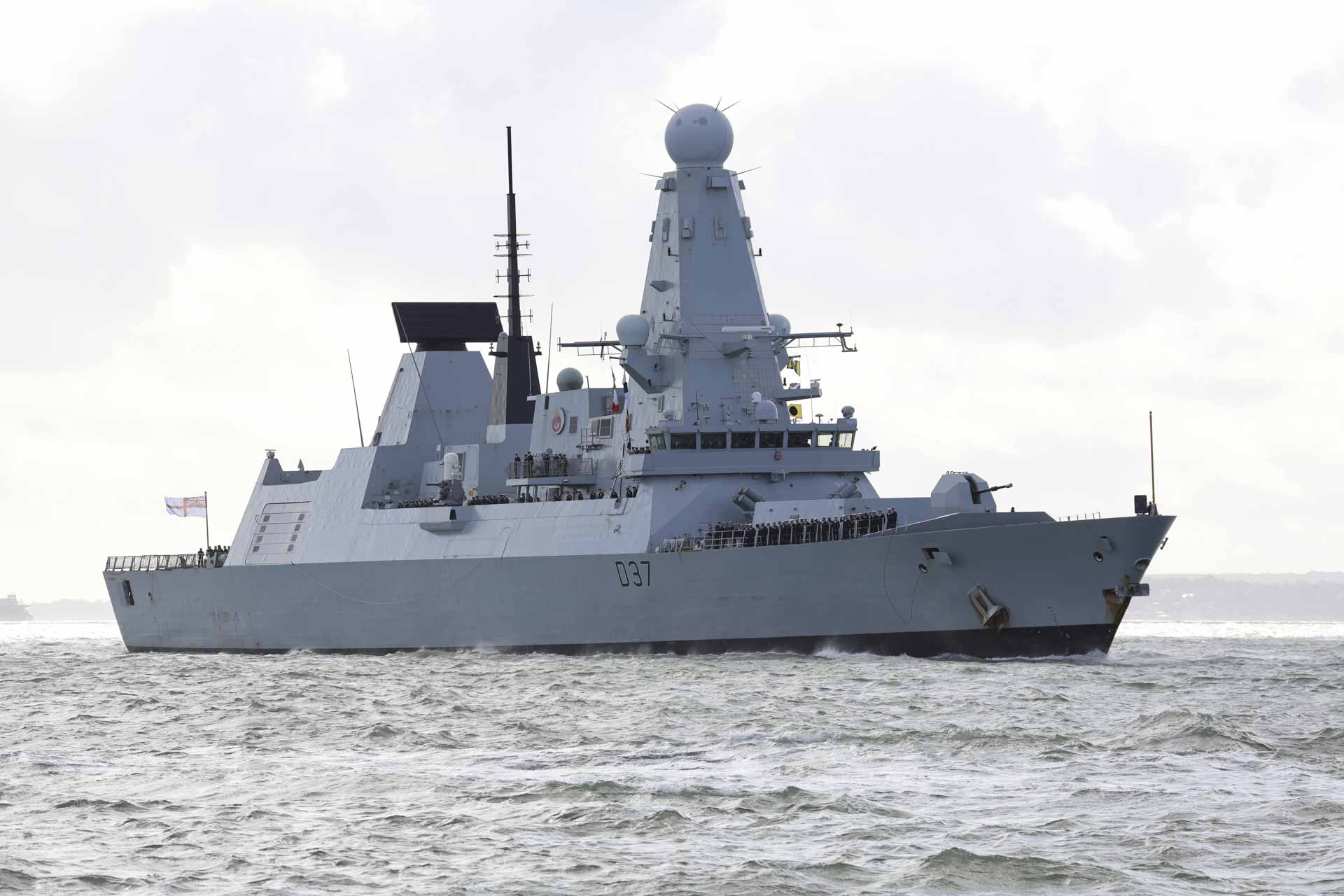
Formally established in 1546 by King Henry VIII, the Royal Navy (RN) is the oldest branch of the UK’s armed forces and is therefore known as Britain’s ‘Senior Service’. Historically, it has played the central role in the defence of the British Isles and the projection of British power overseas. William Shakespeare described the British Isles as ‘This precious stone set in the silver sea’, a ‘fortress built by Nature for herself, Against infection and the hand of war’[1]. As an island nation situated off the coast of continental Europe with the Atlantic to its west, the Norwegian Sea to its east and the Arctic Ocean to its north, credible and effective sea power is an essential foundation of British national security. The centrality of the Royal Navy to the security of the UK has long been recognised and was reaffirmed in the July 2025 Strategic Defence Review (SDR). Maritime security is therefore of primary importance to the UK – as it is to Europe more widely; NATO’s 2022 Strategic Concept identified maritime security as the ‘key to our peace and prosperity’.
Yet over the past three decades, the Royal Navy has suffered from successive cutbacks and reductions. Decades of underfunding and underinvestment have left the RN with outdated equipment and personnel shortages, and the navy is now the smallest it has been since the English Civil Wars of the mid-seventeenth century. In the late 1990s, the RN had approximately 30 major surface combatants; today it has 19.[2] Cost-cutting and shrinking budgets have weakened capabilities and undermined its ability to meet the new demands of a much more competitive and hostile international security environment.
It is in this weakened condition that the Royal Navy is called upon to protect British interests in the face of a plethora of new threats and challenges. The UK faces a ‘generational challenge’ which is ‘more serious, more immediate and more unpredictable’ than at any time since the late 1930s.[3] Blaise Metreweli, the new head of MI6, has stated that the UK ‘is now operating in a space between peace and war’; Russia, she noted, was ‘testing us in the grey zone with tactics that are just below the threshold of war’ and ‘our world is more dangerous and contested now than for decades’, with an ‘interlocking web of security challenges’.[4] Adding insult to injury, President Trump’s erratic and idiosyncratic foreign policy has cast doubt on the reliability of the US commitment to NATO, belittled the capabilities of Britain and its European allies, and threatened the territorial integrity of key NATO allies.
In an increasingly tense and volatile security environment ‘between peace and war’, the Royal Navy is called upon to fulfil three key tasks: first, defence of the UK; second, contributing to deterrence and defence of the Euro-Atlantic area (primarily by contributing to NATO’s three core tasks of deterrence and defence, crisis prevention and management, and cooperative security); and third, contributing to global peace and security. The RN is consequently facing unprecedented demands on its skills, resources and capabilities. This at a time when its small fleet is stretched then and suffering from outdated equipment and personnel shortages. The RN has an unrelenting operational schedule as it seeks to fulfil a range of demanding missions, from providing continuous at-sea deterrence (CASD) and antisubmarine patrols in the North Atlantic, to monitoring Russia’s ‘shadow fleet’, freedom-of-navigation operations in the Taiwan Straits and patrolling global trade routes. Successive cuts in the size and capabilities of the Royal Navy since the end of the cold war has left it perilously over-stretched and hollowed out. The problems of overstretch were starkly illustrated in March 2026 during Trump’s ill-conceived attack on Iran, when the UK had no warships in the Mediterranean capable of contributing to the defence of British bases in the region – notably Akrotiri in Cyprus.
However, Britain is now undergoing a ‘once in a generation’ rearmament programme based on the ambitious plans outlined in the 2025 Strategic Defence Review.[5] This proposed a radical transformation of the armed forces to strengthen integration and synergies between them and move towards ‘warfighting readiness’. It has been described as potentially signifying ‘the most profound change in about 150 years in how you think about the Army, Navy and Air Force’.[6] The armed forces will receive new investment and at the same time be transformed into a ‘more lethal, integrated force’ utilising AL and autonomous systems alongside more conventional capabilities. The long-term aim is to forge more integrated armed forces to enhance synergies and strengthen interoperability between them. Central to this will be digital command and control systems linking all branches of the armed forces and integrating them with advanced weapons and enhanced senor networks to create a more lethal ‘kill net’.
For the Senior Service, this vision of a technological transformation has profound implications. The RN is now being recapitalized, modernised and expanded. Over the next decade, it will receive significant new investment and by the second half of the 2030s it should be significantly more powerful and capable. The plan, however, is not simply to expand the navy as it is, but rather to fundamentally transform it with new technologies and capabilities along the lines outlined in the SDR. The UK’s shipbuilding and ship repair industry has atrophied, along with related maritime technological industries. The parlous state of shore-based maritime defence industries, as well as the notoriously slow and cumbersome nature of UK procurement policy, mean that traditional naval expansion involving long-term procurement projects lasting a decade or more to build major surface vessels is no longer a viable option. The recapitalization and modernisation of the RN is also taking place in the context of a new ‘revolution in military affairs’, which is transforming the character of contemporary warfare through rapid scientific and technological innovation. Consequently, British naval chiefs have outlined a radically new vision of the Royal Navy designed to meet contemporary strategic challenges and exploiting the opportunities presented by technological and scientific innovation.
The vision is a ‘hybrid navy’ combining crewed vessels alongside uncrewed and autonomous platforms, integrated within AI-enabled digitalised surveillance and targeting networks linked to advanced weaponry. This, it is argued, will create a ‘more powerful but cheaper and simpler fleet’.[7] Existing platforms and assets (such as destroyers, frigates and submarines) are to be equipped with new capabilities and new technology, and linked to next-generation platforms. New sensors and technologies for sea surveillance – undersea, on the sea and above the sea – are being developed. The RN is currently testing and trialling new autonomous and uncrewed systems (such as autonomous mine-hunting drones), and the Ministry of Defence has established a Defence Uncrewed System Centre (DUSC) for all three services to provide better co-ordination and cooperation across defence, industries and academia.[8] Considerable investment is going into Directed Energy Weapons (DEW) capabilities, and new laser directed energy weapons are being tested, including the DragonFire laser which is to be fitted on Type 45 destroyers in 2027. DragonFire will form part of a layered air defence system which will reduce reliance on more expensive ammunition.[9]
The First Sea Lord General Sir Gwyn Jenkins has been very clear in outlining the new vision of a hybrid navy and identifying the challenges that face the RN as it seeks to reach warfighting readiness. Addressing the Defence and Security Equipment International (DSEI) conference in September 2025, he argued that ‘together we will reimagine the Royal Navy as a new hybrid Navy’ and effect ‘a strategic transformation in how we project power, preserve lives, and adapt to the pace of modern warfare’. The RN will ‘move to dispersed but digitally connected fleet of crewed, uncrewed, and autonomous platforms that will redefine maritime military power’. Uncrewed and autonomous platforms will be central to this vision of a ‘larger and more lethal fleet, with greater agility and speed’; ‘We have a bold vision, which will place our country in the vanguard of autonomous warships and maritime warfare – under, on, above and from the sea’. This, he insisted, was ‘not an aspiration for some distant point in the future’ but was ‘a necessity now’. The guiding principle for this strategic transformation of maritime military power, he argued, was ‘simple but powerful principle: ‘uncrewed wherever possible; crewed only where necessary’’.[10]
The First Sea Lord illustrated this by providing three examples ‘of what we need to do above, under, on and from the sea’. The first was the creation of Europe’s first ‘Hybrid Airwings’ for the RN’s two aircraft carriers by the end of the decade. These will consist of a ‘fusion of crewed and uncrewed platforms, optimised for speed, survivability, adaptability and combat power’, as well as single-use drones and long-rang strike capability. The two Queen Elizabeth class carriers currently lack a full complement of carrier-capable warplanes and pilots trained to use them, but 48 F35Bs are currently on order. Creating ‘hybrid airwings’ will involve modifying both carriers so that they can launch drones alongside the F35Bs, and the aim is to launch ‘the first jet-powered collaborative platform drone as a concept demonstrator off a Queen Elizabeth-class aircraft carrier as soon as next year’.
The second example of the hybrid navy was ‘Atlantic Bastion’. This he argued was a ‘groundbreaking concept revolutionising how we protect the UK and its allies in the underwater environment’ from the mid-Atlantic Ridge to the Norwegian Sea’. The Atlantic Bastion will consist of a networked ‘blend of crewed and uncrewed host platforms’ capable of independent operations that will create ‘a system of systems’ to ‘find, track and if required act against our opponents, adding both mass and lethality to our already capable submarines, ships and aircraft in the North Atlantic’. The first operational sensors have been deployed in 2026 consisting of five Teledyne Marine Slocum G3 gliders in combination with Apex floats which are designed to collect meteorological and oceanographic data and transmit it to a distributed network of autonomous systems and specialised deployable teams.[11]
The third example was the Type 26 frigate, an advanced anti-submarine frigate, which is central to fleet modernisation, and which will be closely integrated with Norway’s five Type 26 anti-submarine frigates. In the near future, the First Sea Lord argued, each Type 26 frigate would be deployed with two uncrewed escorts, using ‘AI to work in tandem with the warship. Together, they provide a three-ship task group in their own right’. These escort vessels would be relatively simple to produce and could be configured to specific mission requirements, providing the Type 26 with additional sensors, weapons and decoy capabilities. This, he argued, could be achieved ‘within the next two years’ (i.e., by 2027), and would ‘revolutionise our ability to put mass to sea, it will fundamentally change our future shipbuilding programme, enable us to break the paradigm of only ever bigger, more expensive and complex warships’. This use of escorting uncrewed autonomous vessels could be replicated for other parts of the fleet, including the future Type 83 air defence destroyer currently under development, as well as future littoral ships.
Transitioning to the new ‘hybrid navy’ outlined by Sir Gwyn Jenkins is a gradual and long-term project. Many of the current rearmament plans will take years if not a decade or more to produce tangible results. Creating a ‘hybrid navy’ or an ‘Atlantic bastion’ involves new technologies that will take time to test, produce and deploy. The problem is that multiple NATO intelligence agencies and defence analysts are warning that the Russians are already intensifying their grey-zone aggression against Europe and that Putin may be tempted to test NATO’s unity and resolve within the next few years. All militaries face what has been termed the ‘iron triangle’[12]: a trade-off between short-term readiness (‘fight tonight’, which largely involves expenditure on currently available equipment, training, logistics and stockpiles); long term modernisation (‘fight tomorrow’, involving investment in research and scientific innovation to produce enhanced capabilities, advanced weapon systems and technologically sophisticated enablers); and force structure and size, finding the appropriate balance between niche and full spectrum capabilities, and between quality and mass. The Royal Navy is no exception to this and, like all NATO militaries[13], is currently grappling with how to configure its own ‘iron triangle’.
The immediate problem is that the UK armed forces are not currently ready to ‘fight tonight’. A Defence Committee Report from 2024 noted that the UK armed forces were falling behind in all three areas it investigated: operational, warfighting and strategic.[14] The First Sea Lord has recognised the urgency of transitioning to warfighting readiness;
The world has changed. The threat we now face is more serious and less predictable. We must act now and move rapidly to a position of warfighting readiness. We must be combat ready, as one integrated force working together across Defence and the nation to deter threats and strengthen our national security. War is a possibility, and the Royal Navy must be ready.[15]
General Sir Gwyn Jenkins has acknowledged that the presumption of a ‘peace dividend’ over the past three and half decades has led to a reduced fleet size and the ‘inevitable readiness challenges.’ In September 2025 he declared that his mission, ‘is to move the Royal Navy to warfighting readiness over the next four years’;
Our job is to be ready to fight with what we have now, not what we hope to have in the future. Within 100 days, we will have defined, war-gamed and agreed a plan to ensure the Royal Navy is credible and moves to warfighting readiness over the next four years.
He reiterated this at the RN’s Warfighting Conference at HMS Collingwood in February 2026: the RN, he insisted, must be prepared to fight with the ships, equipment and personnel it currently has; ‘And this is where I must be absolutely clear: we fight with what we’ve got. This is not a slogan. It is a statement of intent. It is the hard yards of leadership excellence that will determine whether we succeed or fail’.[16]
To do this, he argued, ‘we need to transform ourselves’ to create a hybrid Navy. This will require the active help and participation of partners in industry – particularly in terms of the design and development of AI-enabled autonomous uncrewed systems, which will be integrated with conventional crewed platforms;
We will all, together, need to lead our allies into a different way of warfare, rediscover how to fight at scale and have the courage to transform so that we can win that fight. Lead, fight, win – to make Britain secure at home and strong abroad.
The transition process is outlined in the Warfighting Ready Plan 2029 which has been published internally across government and structuring engagement with industry, academia and allies. The then Defence Minister Luke Pollard has made clear that it is seen as an iterative plan ‘designed to deliver significant transformation over the next four years whilst responding to emerging threats, novel capability and confirmed resource allocation’. It does not therefore follow the traditional schema of a linear plan of action leading to a single milestone of full operating capacity. Rather, it is a programme for continuous transformation, focusing on speed of decision-making, innovation and ongoing implementation. The transition to warfighting as ‘a discipline for action’ involving stripping away bureaucracy and ponderous decision-making and administrative processes.[17]
Central to the transition to warfighting readiness is ever-deeper cooperation with allies. Gone are the days when Britannia alone rules the waves. Today the RN can only achieve its core missions by cooperating with allies and partners. The First Sea Lord noted that the Warfighting Ready Plan 2029 has been developed ‘on the back on extensive wargaming to understand our weaknesses and our strengths, to understand where we can complement our allies and where they can complement us’.[18] Closer cooperation with allies was also essential because the pace of technological innovation was accelerating and transforming the maritime environment ‘faster than at any point in our naval history’. Consequently, he argued, it was essential to work closely with allies. ‘In order to meet this challenge, we must work together with our key allies’ so that we can adapt to ‘this evolving technological world’ and be able to adopt ‘new approaches across our allied nations to meet the threats before us’.[19]
As a middle power, alliances and strategic partnerships are vital for the UK. They provide a means of strengthening influence and enhancing the ability to shape the external milieu. Current British strategic thinking is focused on northern Europe, where the UK is seeking to position itself as a key player in the security of the region, including the Nordic-Baltic region, the Atlantic and the High North. Political and diplomatic cooperation already exists in the form of the Northern Group, an informal forum for consultation and pragmatic ad hoc cooperation between countries bordering the North and Baltic Seas. The Joint Expeditionary Force (JEF) also provides a functioning military grouping that is well-suited for responding to challenges and crises at the sub-threshold level. At the 2026 Warfighting Conference in February, the First Sea Lord announced he would convene a Northern European Navy Chiefs summit in London in April 2026. ‘I am bringing together the Northern European Navies to develop our combined approach to the growing threat in the North’, he noted, arguing that,
The United Kingdom is taking the lead because this threat demands a unified response, and our geography, capability and historic role in these waters mean we must be at the forefront. Only through strength, delivered by operating and developing even more closely together, will we face down the threats we now face.[20]
The conference met on 23 April 2026 and brought together senior naval chiefs from the JEF to discuss cooperation and enhanced coordination to counter Russia’s Northern Fleet and its shadow fleet, as well as Moscow’s grey-zone aggression against critical underwater infrastructure. Enhanced naval cooperation is seen by the Royal Navy as crucial to its ability to move to warfighting readiness and strengthen deterrence in the North Atlantic, High North and Baltic Sea. The aspiration is for a much deeper partnership involving shared logistics and stockpiles, regular cross-navy training, common platforms and integrated digital networks, thereby creating a fully integrated and interoperable naval capability in northern European waters.[21]
As always, the deeper problem for the UK and the Royal Navy is the disconnect between strategic ambition and fiscal imperatives. The current Labour government pledged in February 2025 to increase defence expenditure from 2.5% to 2.7% by 2027, but the new Chancellor John Healy (the former Defence Security who resigned over Sir Keir Starmer’s unwillingness to further increase the defence budget) has still refused to commit the government to meeting the 3% target by 2030. The next budget is due later this autumn on 28 October and it remains to be seen whether the Chancellor will commit to 2030 as the target date.[22] The UK is fiscally more constrained than countries like Germany or Sweden and cannot afford substantial additional borrowing and debt. However, the political and military problem is that although the UK government has raised defence spending, it has not raised it as quickly or to the same extent as its NATO allies in northern and eastern Europe. These countries are the UK’s favoured partners within the alliance, with whom it shares similar strategic interests and concerns. The UK – and the Royal Navy – seek to lead in northern Europe, but as the country slips down the NATO league table in terms of spending, its risks losing status and influence – which since Brexit has been a central concern of British diplomacy and foreign policy.[23] Once again, funding – or rather the lack of it – remains the Achilles heel of British grand strategy.