

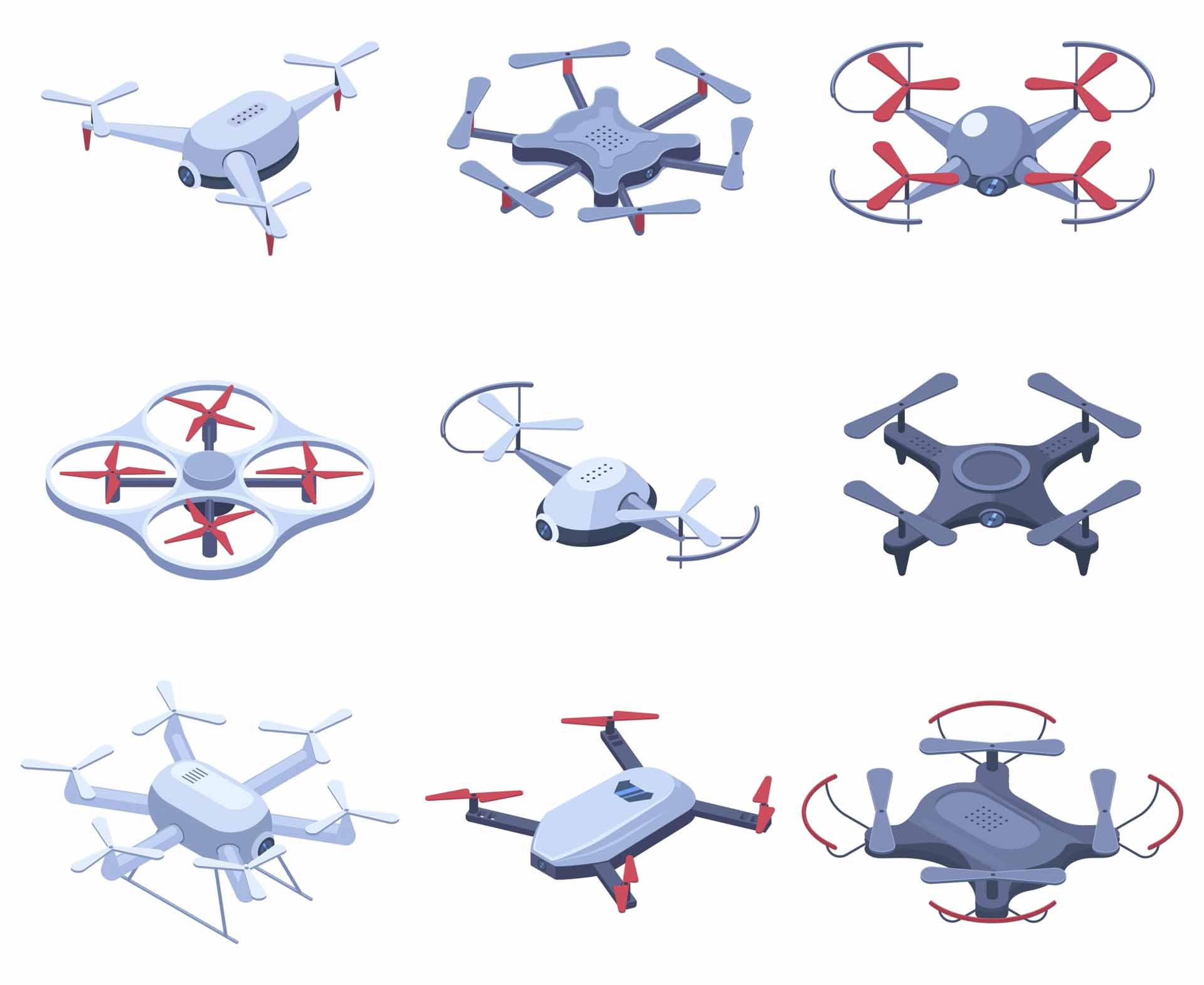
Thinking before buying matters more than perhaps in a long time in defence procurement. Across Europe, defence budgets are rising to levels not seen in a generation, and the instinct in many capitals is to look at Ukraine and do what Ukraine does. As a guiding idea this is sound. As a procurement strategy it needs constant testing against one inconvenient fact: Sweden and almost every other European country are not at war. They are building up forces, as fast as possible, precisely in order to deter Russia from ever making that fact obsolete.
The qualification matters. Europe is not at war, but it is no longer quite at peace either. Airspace incursions and drone sightings over airbases and airports have already turned counter-drone capability into a standing peacetime requirement rather than a wartime contingency — which, as we shall see, cuts against part of the logic that applies to strike drones. What that difference implies for the purchase of defence materiel is less obvious than it looks — and nowhere less obvious than for drones.
Ukraine’s unpleasant advantage
Ukraine has what might be called the unpleasant advantage of being at war at an intensity that consumes materiel almost as fast as it is produced. Equipment is expended, evaluated and replaced in a continuous loop. What was manufactured a month ago is tested in combat today, and next month’s batch incorporates the lessons. The renewal is fastest in software, but it reaches hardware too. The drone is the emblematic case: airframes that are often industrially unremarkable — they must be producible quickly, domestically and in volume — carrying mission software, navigation and electronic-warfare resistance that evolve in cycles measured in weeks. Iteration speed, rather than platform sophistication alone, has become the combat edge.
Russia, under the same pressure, iterates the same way. This is the crux for peacetime Europe. A country that today buys large stocks of finished drones is acquiring a snapshot of a technology race it is not itself running. The systems risk ageing in storage while the potential adversary continues to be schooled daily at the front. The problem is not hypothetical: Finland’s defence minister has said plainly that a drone model can be out of date a month after it enters storage, as software, communication links and the radio-frequency environment move faster than traditional munitions ever did. Financial Times reporting in February 2026 found several European states struggling to replicate Cold War-era depot logic for equipment with a technological half-life measured in months.
In five years, a warehouse full of 2026-vintage drones may be worth little more than its airframes — the software assumptions, the frequencies, the counter-jamming techniques all superseded. Some components will retain considerable value, however, if systems are modular, interfaces remain open, and software, communications modules and payloads can be replaced. The procurement problem is therefore not simply how many drones to store, but which layers of the system can be stored without freezing the whole design. A system that rewards units delivered rather than capability sustained will buy technological lag in bulk, and will do so entirely in accordance with its own rules.
The organisational answer: prototype, iterate, scale
One solution, easy to state and hard to organise, is to hold continuously evolving prototypes and small hot production lines in close contact with Ukrainian combat experience, and to buy not stockpiles alone but the proven ability to scale those lines very quickly when needed. In this model the state pays for five things: a development loop wired into real battlefield data; a modest steady output that keeps engineers, toolmakers and supply chains current; pre-negotiated surge capacity; reserves of long-lead components and critical materials; and trained units that continuously fly, test and improve the systems. The stockpile shrinks to what deterrence credibly requires on day one; additional endurance comes from replenishment capacity that has been financed, tested and exercised before the crisis. The rest is bought as industrial capacity, not as objects.
This is not an argument against stockpiling. It is an argument for differentiated stockpiling. Finished systems are needed for immediate readiness; selected components, energetics and raw materials are needed to sustain production; modular architectures are needed to prevent the first category from becoming obsolete before it is used. The EU’s own Readiness 2030 framing points the same way — strategic stockpiles with sufficient industrial capacity for timely replenishment, not one instead of the other — and CEPA’s 2026 assessment adds that surge capacity is credible only when backed by fast-track emergency authorities, coordinated stockpiling of critical materials and predesignated industrial conversion pathways. The relevant calculation is the time from political warning to usable surge output, not the nominal capacity printed in a contract.
There is also a physical limit that no contract can remove. A hot line and a surge clause deliver nothing without magnets, lithium cells, carbon fibre and gallium-nitride chips, and these remain overwhelmingly Chinese — roughly ninety per cent of global sintered-magnet output alone. Ukraine has pushed the Chinese share of its drone components down from near-total in 2022 to something under forty per cent by 2025, while the EU has meanwhile had to allow Ukraine to spend part of an EU-backed financing tranche on Chinese drone components. Surge capacity that cannot be fed is a promise, not a capability. Components, unlike software, do not necessarily age — which makes them the one category that genuinely should be stockpiled.
This form of defence-industrial organisation is no longer theoretical. Elements of it are being implemented, in different variants, by a limited set of European countries — and the variation between them is itself instructive. Three tiers can be distinguished. They are cumulative rather than exclusive, and the boundaries are already dissolving: read them as three organisational commitments — money, licences, contract form — that a state may hold in any combination, not as a ladder.
Who actually does this? A country overview
Tier one: paying for Ukrainian production. Denmark pioneered the simplest and fastest variant. Under the »Danish model«, partner governments finance contracts placed directly with Ukrainian manufacturers, after Danish officials vet the companies and their delivery records. Foreign funding of Ukraine’s defence industry reached some 6.1 billion dollars in 2025, against roughly 600 million the year before. The Danish model in the narrow sense accounted for around 1.3–1.4 billion euros of that; taken together with its national variants in Norway, Sweden, the Netherlands, Lithuania, Iceland and Canada, CSIS assessed in late 2025 that the family of mechanisms moved close to six billion dollars into Ukrainian production lines — an expansion of roughly sixty per cent on top of Ukraine’s own ten-billion-dollar weapons procurement budget. The primary purpose is aid: money can often buy more immediately relevant capability per krona in Ukrainian factories than through conventional Western procurement. But the secondary effect is the one that matters here — the funders acquire insight into, and relationships with, the fastest-iterating defence-industrial ecosystem in the world.
Tier two: licensing and onshoring Ukrainian designs. Denmark and the United Kingdom have gone a step further. In Vojens, next to the Skrydstrup air base that hosts Danish F-35s, the Ukrainian missile and drone firm Fire Point is building the first Ukrainian defence-manufacturing site on NATO territory; the first phase is planned for 2026, subject to permitting, with full-scale operations envisaged for 2027. In Britain, a licence agreement signed in November 2025 covers the Octopus interceptor drone, developed by Ukrainian engineers against the Shahed threat, with production targeted at a thousand units a month from February 2026.
One caveat deserves emphasis, because it is easily misread: the British-built Octopus units are transferred to Ukraine, not stockpiled for British forces. What the United Kingdom acquires is therefore not inventory but a licence, a hot line and a trained workforce. That is precisely the asset this article argues is worth more than inventory — and it is the strongest available evidence for the thesis. Other Ukrainian firms, including Ukrspecsystems, have announced long-term production investments in the United Kingdom. The knowledge flow has visibly reversed: designs matured under fire in Ukraine are now scaled in Western factories.
The tier-two path is nonetheless narrower than it looks. In July 2026 Kyiv published a framework for wartime defence exports: only partner states that have signed drone agreements with Ukraine may contract directly with Ukrainian manufacturers; the defence ministry maintains a list of critical items that may not leave the country; transfers take place without assignment of intellectual property, and re-export requires Ukraine’s prior written consent. Interceptor drones may be exported only if the manufacturer can guarantee that Ukrainian requirements are met first. A European government contemplating a licensed line must accept three things: that it stands second in queue behind the Ukrainian armed forces, that it will not own the design, and that its access depends on a bilateral political relationship requiring continuous maintenance. This is not an argument against tier two. It is an argument for entering it early, while the queue is short.
Tier three: rebuilding national procurement around iteration. Germany has become the most interesting test case. During 2026 the Bundeswehr moved to procure loitering munitions from two software-first companies, Helsing and Stark — not from the established primes. The Bundestag approved an initial package of roughly 536–540 million euros, and Stark subsequently confirmed a framework contract covering several thousand systems over two years. The original framework reportedly envisaged options reaching 4.3 billion euros, but parliamentary budget scrutiny cut the prospective ceiling to around two billion, with a cap of one billion per company. Both contracts carry an »innovation clause« obliging suppliers to offer continuously updated technology rather than the state agreed at signature, with the state able to request adaptations up to twice a year and renegotiate price if technology drives costs down. Germany, in short, is trying to write the Ukrainian feedback loop into the contract itself.
How far Germany’s conversion actually reaches is a fair question — and the halving of the framework ceiling is itself the answer in miniature. The innovation-clause contracts coexist with a procurement bureaucracy that still runs on multi-year planning documents, and the political economy of German rearmament pulls toward exactly the large, fixed-specification orders the new model is meant to replace. Germany is running both systems at once: a classical scaling of tanks, air defence and ammunition, with an iterative drone-and-software track grafted on. Whether the graft changes the tree or the tree smothers the graft remains one of the more consequential open questions in European rearmament.
Around these tiers, a multilateral scaffolding is emerging. BraveTech EU, launched on 11 July 2025, is the first joint EU–Ukraine defence-technology instrument: 100 million euros split evenly between the Union and Ukraine, wiring the European Defence Fund and EUDIS to Kyiv’s Brave1 cluster, with a further 35 million entrusted to the European Defence Agency in April 2026 for testing in operationally realistic conditions drawn from the war. NATO has institutionalised the learning loop through JATEC in Bydgoszcz and, since the 2025 Hague summit, a Rapid Adoption Action Plan setting a general ceiling of 24 months from identified need to fielded system. That is a genuine acceleration by alliance standards. It is also roughly twenty months longer than the iteration cycle it is meant to keep pace with — which is why rapid adoption must be complemented by continuous contractual upgrading after adoption.
What follows for Sweden
Sweden’s starting point is better than tier-one membership alone suggests. FMV’s Military Innovation Challenge for Ukraine already runs multi-stage competitions on themes such as counter-swarm defence, funds selected concepts through development, and — the significant detail — puts proposals before a jury including Ukrainian representatives, creating direct dialogue between supplier and end user. Saab received a national counter-UAS order in April 2026. The gap is not the absence of an iteration loop; it is scale, and the absence of a contractual form that lets the loop survive contact with the annual budget cycle. The contrast is instructive: an earlier FMV drone procurement for the army and Home Guard took four years and two months from start to delivery.
Five conclusions suggest themselves.
First, distinguish ruthlessly between the exquisite, the attritable and the standing. For high-end platforms with decade-long lives, classical procurement logic still holds. For strike drones and loitering munitions — consumables in modern war — buying large finished stocks without modularity, upgrade arrangements and replenishment capacity is the clearly wrong answer. Interceptors are the exception that proves the rule: because peacetime airspace violations are already routine, some magazine depth must exist on any given Tuesday, not on mobilisation day. Buy sufficient operational stocks for immediate readiness and for the period before surge production becomes effective, and put a substantial share of the remaining money into contracted surge capacity, iteration and critical-component reserves.
Second, buy the loop, not the snapshot. Contracts should incorporate the most promising elements of the German approach: software-defined systems, innovation clauses, combat-informed upgrade cycles — and, where possible, licensed production of Ukrainian-proven designs rather than parallel reinvention. Sweden already participates in tier one through the Danish model; the natural next step is a tier-two element, a licensed line with a Ukrainian design house. The deepening Swedish–Ukrainian industrial relationships, forged around high-end platforms such as Gripen, provide an obvious political framework for expanding into rapid-iteration drone production — but the relationship, not the platform logic, is what transfers. Such cooperation should not stop at final assembly. Sweden should seek access to design authority, software interfaces, test data and the right to modify systems rapidly under national operational conditions. Without that, a licensed line reproduces the snapshot problem one step downstream.
Third, keep the comparison with Ukraine honest. Ukraine optimises for this month’s survival; Sweden must optimise for credible mass at an unknown future date, for operations within NATO’s regional plans, and for the ability to catch up fast. Copying Ukraine’s products misses the point – with its different geostrategic position and more. What deserves copying is the organisational form — the short distance between user, engineer and factory — institutionalised now, in peacetime, so that it does not have to be improvised under fire.
Fourth, accept that this is a procurement-culture reform, not a shopping decision. Innovation clauses, hot lines and surge contracts sit uneasily with annual budget frames, legal challenge cultures — including stringent interpretations of defence procurement law (LUFS) — and audit logics built for tanks and frigates. Denmark showed in September 2025 how far this can be pushed: to get the Fire Point plant built, the government temporarily suspended more than twenty laws and regulations covering spatial planning, construction, energy, forestry, environmental protection and major-accident risk. Whether Sweden should go that far is a legitimate question. That the question has to be asked at all is the point. The objective cannot be to dispense with accountability but to redesign it — auditing learning rates, delivery times, modularity and demonstrated surge performance rather than mere compliance with a specification fixed years earlier. The countries listed above are not those with the biggest budgets but those that changed the organisational form, and that change must reach inside agencies such as FMV, not merely be recommended to them.
Fifth, be honest about what remains untested. No European state has yet executed a surge under a surge contract. The pre-negotiated capacity in these agreements is a legal instrument whose performance under mobilisation conditions — competing national claims on the same subcontractors, export controls, labour, energy, component supply — is unknown. Buying the loop is the better bet, not a safe one. It should be hedged: component stocks, more than one supplier per function, and at least one exercised surge before anyone treats a contract as a capability.
Thinking before buying, in 2026, means exactly that: the scarce resource is not money alone but the institutional ability to change what you are buying while you are buying it — without losing readiness, accountability, or the capacity to fight on day one. Taxpayers have a right to know and understands what happens with their money.