

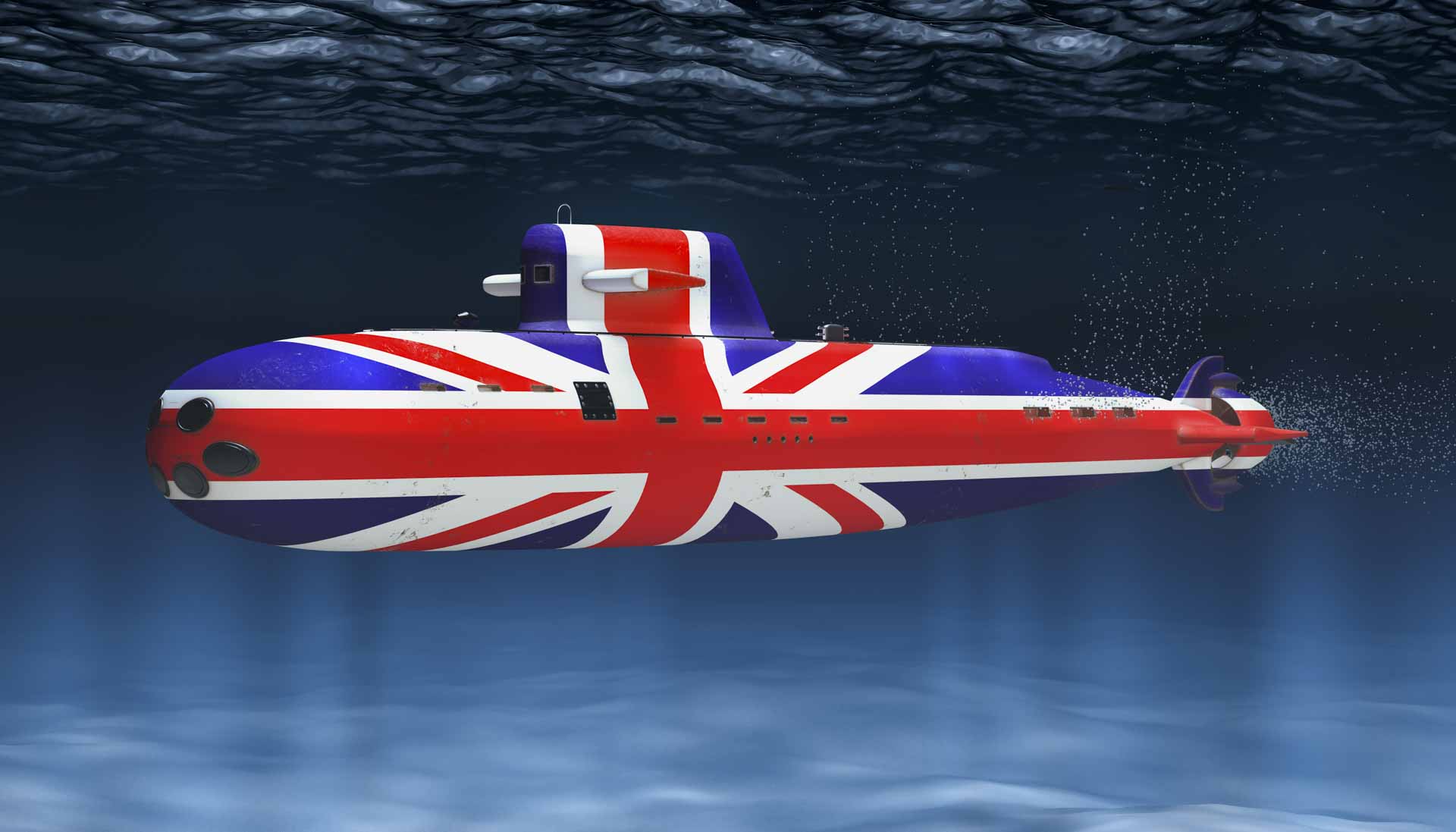
The European pillar of the Allied nuclear deterrence capability is insufficient. Its main weakness is the serious lack of sub-strategic nuclear assets which Russia exploits ruthlessly. UK, in particular, and France can solve the problem with allied support.
After the Russian full-scale invasion of Ukraine, we live in a new era. The Trump administration is preparing a European Defense Review, to be published in the coming months as the US defines its new position as NATO 3.0. Its main feature can be summarized in the new term burden-shifting (as opposed to the old burden-sharing), meaning that NATO’s European Allies are taking over considerably more responsibility of the Alliance’s conventional defense while the nuclear deterrence part of NATO defence would still essentially remain in US hands.
That distribution of roles is, however, a folly, as deterrence is built on two inseparable pillars, conventional and nuclear deterrence – in that order. Nuclear deterrence is designed to step in if conventional deterrence fails, giving nuclear weapons their distinctive role as weapons of last resort.
Three senior former high-ranking US nuclear professionals addressed this issue in more detail in Foreign Affairs in September 2026. Excerpts:
“What is fundamentally at issue is the credibility of U.S. threats to use military force—both conventional and nuclear—if NATO is overtly threatened or attacked. As the late British nuclear policymaker and scholar Sir Michael Quinlan once noted, nonnuclear war is “the likeliest route to nuclear war—in practice indeed the only likely route. . . . The risk would be at its highest when bitter conflict had already broken out at a lower level. War-prevention needs therefore to operate upon all levels of military conflict between nuclear-capable states.”
Any serious consideration of the use of nuclear weapons is overwhelmingly likely to come in either an imminent or ongoing conventional war. Conventional and nuclear deterrence are inextricably linked. The presence of U.S. nuclear forces on European territory during the competition with the Soviets was always intended to broadly couple the defense of the United States with that of Europe. Reducing Washington’s contribution to the conventional defense of the continent ultimately weakens both conventional and nuclear deterrence against renewed Russian aggression.”
This returns us, however, to the post-Korean War debates that led to the rearmament of West Germany and the creation of the military arm of the Western European Union, and, like then, seems to be a compromise that most NATO member states can live with. The main reason for this thinking is money as the security community consensus is that building a sufficiently strong “European” nuclear force would be prohibitively expensive.
Cold War Deterrence
NATO strategic doctrine originally held that any attack by the Soviet Union would be automatically met with overwhelming nuclear response by the United States, including nuclear landmines on the inter-German, Italian, and Turkish borders.
This “massive retaliation” doctrine changed to “flexible response” across the 1960s, with the increased participation of Allies in nuclear planning. The key milestones of the Athens Guidelines of 1962 and the Nuclear Planning Group of 1966 meant that Allies had a say in the scale and scope of nuclear responses to a Soviet attack, shifting the nuclear response further from automaticity. Extended deterrence in the form of nuclear sharing became the political tool of choice. Its most important building blocks are mutual trust based on shared risk.
New Russia, New Problems
After the end of the Cold War, the nuclear threshold shifted further, where NATO nuclear use was seen only as a last resort in the increasingly unlikely case that conventional deterrence fails. Vladimir Putin’s Russia turned the clock back, with reckless nuclear threats and fielding short- and intermediate-range air, sea, and land-launched nuclear missiles, including Iskander and much hyped Oreshnik – with its apparent poor accuracy – missiles in Belarus.
Russia’s moves signaled the return of nuclear warfighting, with the option of overwhelming use of Russian nuclear forces early in a conflict – an option that the West did not take seriously before it was too late, and emboldening Putin to seek to restore a new version of the old Russian Empire.
At present, the US administration has raised doubts among NATO member states as whole on its binding security guarantees, including the assured use of all types of US weapons if NATO is attacked. Individual countries may feel more positive than others, but that may simply be due to bilateral transactionalism rather than a principled solidarity with the Atlantic Alliance. This is a major problem: if the US cannot or will not commit to defend every inch of Allied territory, can its nuclear guarantees be trusted?
The obvious answer to this dilemma is to push past the simple binary question and instead ask what more Europe can do to improve deterrence, particularly in the field of sub-strategic deterrence, where many experts believe that even the current US nuclear sharing capabilities are insufficient. Sub-strategic nuclear weapons, commonly known as tactical nuclear weapons, are at the core of Russia’s current “escalate to win” doctrine, which Russia uses ruthlessly for political extortion and intimidation of its enemies and opponents.
Oddly, there is a lack of courage and vision among the European Allies as to how they can bolster NATO’s deterrence against Russian sub-strategic threats. In the following section, we will address this lack of vision and outline how Europe may improve its position and become a serious US partner also in nuclear deterrence. Will Europe show commensurate courage?
A New European Pillar
The NATO Allies can work together with France and the United Kingdom to strengthen the European pillar of NATO’s nuclear deterrent and credibly stand up to Russia. The rest of the NATO Allies are understandably worried about the future US commitment to NATO. But even without Donald Trump in the White House, the European NATO Allies (plus Canada) can provide the necessary and sufficient resources to deter Russia and reduce the dependence on US nuclear weapons.
Currently, NATO relies heavily on the nuclear capabilities supplied by the United States, supported by the comparatively smaller nuclear arsenals of the UK and France. The US nuclear arsenal includes around 1,700 deployed strategic warheads in its strategic triad of intercontinental ballistic missiles, submarines, and heavy bombers. These strategic forces are supplemented by around 150 air-dropped nuclear bombs stationed in Europe to be delivered by NATO fighter jets in case of war. Including non-deployed warheads, the US total nuclear arsenal consists of around 5,000 warheads.
The UK nuclear deterrent includes around 250 warheads, with four UK nuclear submarines carrying nuclear missiles, and is now purchasing F-35A fighter jets to be ready to deliver US nuclear bombs in the future. France’s nuclear deterrent includes around 290 warheads, with four submarines with nuclear missiles and a small fleet of fighter bombers with nuclear-armed cruise missiles. That’s 540 nuclear warheads total for the UK and France.
NATO faces a Russian nuclear arsenal of close to 5,500 total warheads, with around 2,000 in their active arsenal set to be delivered by air, land, and sea-launched short, medium, and long-range ballistic and cruise missiles, along with nuclear torpedoes and other banal and exotic delivery systems. There are, however, serious questions about the real state of Russia’s nuclear forces and particularly its future.
Russia is, however, no longer in a position to sovereignly decide what composition and strength its nuclear forces will have in the decades to come. Russia’s heavy economic and technical dependence on China introduces new boundary conditions it can’t ignore. The U.S.-China Economic and Security Review Commission noted in August 2026:
“Since Russia’s full-scale invasion of Ukraine in 2022, China has become indispensable to Russia, giving Beijing growing leverage in one of the most consequential strategic partnerships threatening the United States and global stability. …China has become the decisive external enabler of Russia’s war in Ukraine.”
Russia is already a junior partner in the “Axis of Authoritarian States”. China’s strong nuclear build-up should be seen in the light of its ambition to become the world leader by 2049. One likely consequence of that is that China will prevent Russia not only from re-establishing the former Soviet-Russia empire but also from returning to a nuclear power on par with the United States. Pushing Russia down to #3 may well be in China’s long-term interest too. It would deal a devastating blow to the self-image of the Russian elite.
China has for years tried to influence Russia’s nuclear policy and restrain its nuclear saber rattling. It is noteworthy that Russia too took part in the leaders of the five nuclear weapon states statement in January 2022 that
“a nuclear war cannot be won and must never be fought. As nuclear use would have far-reaching consequences, we also affirm that nuclear weapons – for as long as they continue to exist – should serve defensive purposes, deter aggression, and prevent war. We believe strongly that the further spread of such weapons must be prevented”.
When speculations of a possible Russian nuclear use in Ukraine popped up again in the Summer of 2026, Finnish President Alexander Stubb said emphatically that China would stop Russia from going nuclear. He met Chinese Foreign Minister Wang Yi in Helsinki in July when the matter was raised. China has not denied Stubb’s interpretation. The conclusion to be made is that China is taking a firmer hold on Russia’s nuclear dealings.
Russia’s land-based ICBM forces are aging, with key programs in severe difficulties (e.g., Sarmat). The sea-based triad is now perhaps in best shape. Russia’s strategic bomber fleet is aging out, with practically no new production, and humiliating losses to Ukrainian drone strikes. The possibility that Russia’s strategic aviation may evaporate altogether in the foreseeable future cannot be ruled out.
Russia’s dual-use sub-strategic weapon systems give mixed impressions. Its main air-launched cruise missile, the Kh-101, is routinely intercepted by Ukrainian defenses, and is largely the same design as its nuclear-armed brother, the Kh-102, which must be giving Russian operational planners nightmares. Other sea and land-launched sub-sonic cruise missiles also are vulnerable to missile defenses, while its ballistic missiles and hyper-sonic missiles are more difficult to engage.
To sum up, Russia’s nuclear forces should be assessed seriously from facts such as its technological and economic possibilities to fulfil its ambitious rearmament program and not just from dubious parameters like the size of its current nuclear nominal nuclear inventory in order to establish if and how Europe could neutralize its nuclear threats and intimidation. The mainstream perception that Europe cannot compete without a full US nuclear commitment to NATO’s defence needs to be challenged. However, they can.
Yes, NATO Can
At the NATO Hague Summit in 2025, Allies vowed to increase their defense spending, with the vast majority already on track to reach their 5 percent overall defense spending target. On current trends, NATO, subtracting US defense spending, is on track to spend an extra 900 billion Euros from 2026 to 2030 on top of the 2.5 trillion Euros they would have spent without increasing their military budgets from 2025.
Where should that 900 billion go?
The UK has budgeted 74 billion Euros (63 billion GBP) in total to their nuclear deterrent through 2030, including work to replace its submarines, missiles, and warheads. France, in the same timeframe, will spend between 40-50 billion Euros on its deterrent, including modernizing their submarine fleet, missiles, and warheads, as well as a new nuclear-armed air-launched cruise missile (the faster, stealthier ASN4G) and its warhead, too.
That means NATO Europe currently is spending under 120 billion Euros on NATO’s nuclear deterrent. And that is about all the UK and France can afford. They do not have the resources – particularly the money – to go much further – for now.
But what if the Allies chipped in some of that 900 billion just in extra spending to increase the UK and French arsenal? Common NATO funding tools are used frequently to acquire critical capabilities, such as the new Airborne Warning and Control System (AWACs) replacement, the Swedish/Canadian GlobalEye system. What if the NATO Allies paid in to a common fund to double the UK and French nuclear arsenals to more than 1,100 warheads and add more submarines as well as a more distant long-term goal?
What if we went further and asked the UK and France to jointly develop the ASN4G replacement French nuclear-armed ALCM and provide, say, 200 of them to Allies in a parallel arrangement to the US nuclear sharing for its air-dropped bombs? The warheads would be British, perhaps refurbishments of the versatile variable yield warheads of the W.177 bombs retired three decades ago. The British-owned BAE Systems already is participating in the project, and the UK and France already have well-established nuclear weapon cooperation under the Lancaster Treaties of 2010, renewed under the Northwood Declaration of 2025. And France, under Emmanuel Macron’s leadership, is renewing its commitment to European deterrence following his March 2026 speech.
We do not need more nuclear-armed states. Instead, helping the UK and France to increase their arsenal sizes, as long as those weapons remain under UK and French control, is fully consistent with the Nuclear Non-Proliferation Treaty (NPT), of which all NATO states are members. And if the UK provided those ALCMs to NATO under the same controls as the NATO nuclear sharing arrangements, there would be no legal barriers to such cooperation.
Does anyone think Russia would be able to ignore a NATO nuclear deterrent of 1,100 warheads – the Cold War combined British and French nuclear warheads, twice the current level – operationally deployed on submarines and fast, stealthy fighter jets across Europe? How much of Russia would be left if the unthinkable happened and the Allies unleashed that kind of firepower? It’s terrible to think about, but that’s deterrence, and such common spending would, in our opinion, be enough to deter Russia.
There is precedent. While France might not accept direct NATO funding, the UK proposed in 1964 to create the Atlantic Nuclear Force wherein Allies would provide financial support the UK sea and air-based nuclear deterrent in exchange for their use in nuclear sharing arrangements. If the UK and France jointly-developed the replacement ALCM and ensured it was compatible with all Allied fighter-bombers, this would provide NATO with a huge fillip to NATO deterrence.
Finland already is doing its part. It has changed its laws so that in crisis, NATO can deploy nuclear weapons in Finland for strikes against Russia. Finland is increasing its defense spending and is participating in NATO conventional support to nuclear missions at exercises such as STEADFAST NOON. In mid-September 2026 Finland, like many other European countries, decided to participate in the French “Forward Deterrence” and opened bilateral cooperation with France to provide their forces with similar support.
This issue could be raised in the context of the UK-led Joint Expeditionary Force and NORDEFCO formats to build consensus, and members could then work bilaterally with the UK and France to gain their support. Then, the proposal can go to NATO, and those Allies that choose to “buy-in” can do so, and those that choose to “opt out” can as well. There are many areas where Europe needs to spend defense Euros. It should be recognized that while the current security situation in Europe differs significantly from that during the Cold War, NATO still needs a robust sub-strategic nuclear deterrent.
But with 900 billion in addition to 2.5 trillion in five years, Europe can build a mighty pillar of NATO’s nuclear deterrent, while helping the UK and France directly, materially, and tangibly, beyond slogans and thoughts and prayers. Britain would reclaim its rightful place as a serious and capable security provider in Europe.
The conclusion below of the European Study Group in its Munich Security Conference Report (“Mind the Deterrence Gap: Assessing Europe’s Nuclear Options”, February 2026) is to the point:
“The era in which Europe could afford strategic complacency has ended. However uncomfortable the debate may be, the new security environment requires European policymakers to confront the role of nuclear weapons in the defense of the continent directly and without delay – and to invest the resources needed to do so competently. Thinking seriously about these questions today is the price of avoiding strategic failure tomorrow.”