

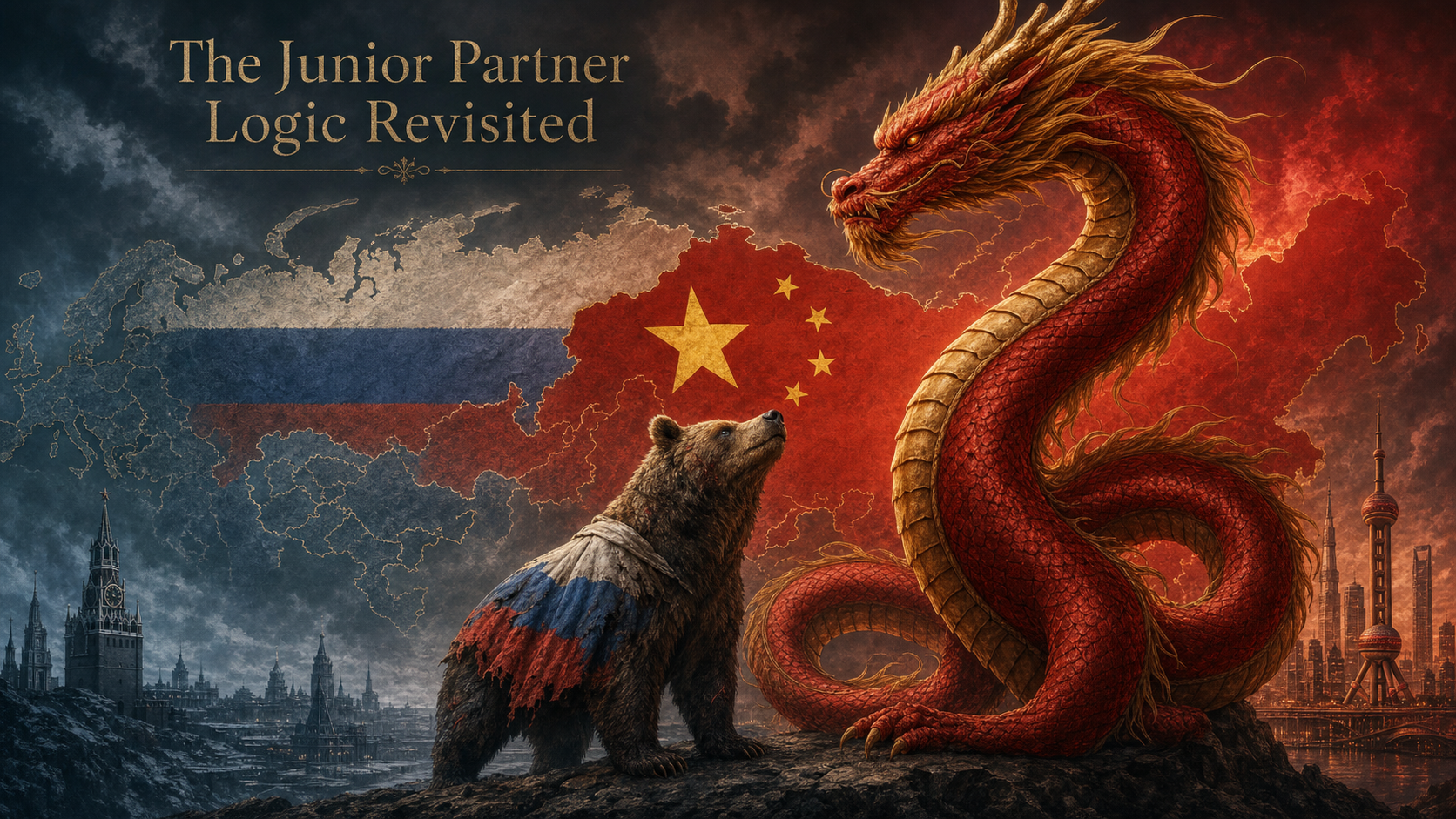
When Vladimir Putin landed in Beijing on the evening of 19 May 2026 — one day after Trump’s plane had left the same airport — Xi could celebrate an unprecedented line of visitors from different parts of the world, including Europe. Xi himself did not have to travel; the others travelled to him. As for the Russian visit: in a relationship long described in the West as a “no limits partnership,” the limits are now visible — but they are more ambiguous than the well-known “junior partnership” notion suggests.
This article considers four claims, of which the fourth is a deliberate complication of the first three. It should be noted that this analysis it is based on an extremely complex and elaborate empirical basis (see the note to the reader below).
One has to look at China from many different perspectives in order to form an opinion about the structural asymmetry between China and Russia. This is the first point. It seems to have hardened into a very important dependence gap. It is no longer just a junior partnership.
Secondly, it is often said that Beijing has a number of red lines in its relationship to Russia and its policies. A closer look suggests that it is rather a question of observable constraint zones — not all red lines in the same sense. And some of these are to be considered as Chinese self-restraint vis-à-vis the West rather than commands directed at Moscow. China enables Russia to a certain extent — but while enabling, there is also a built-in constraint on the use of the capabilities delivered by China. And there are some things that are not delivered by China to Russia.
The third point, a very important one: the Iranian war that began on 28 February 2026 has exposed a genuine divergence of operational interests. But it may be said that it can be compartmentalised — isolated into different issues that don’t necessarily affect the overall relationship between China and Russia.
Fourth and crucially: dependence does not mean subordination, necessarily. Russia retains freedom of action to a certain extent, and an overall destructive capacity — including through the possession of a vast nuclear arsenal — that complicates Chinese efforts to manage Russia as a junior partner.
Beijing’s preferred Russia at present seems to be a functional, dependent but constrained Russia — neither victorious, nor collapsing, nor pursuing nuclear aggression. Different types of flows, dual-use in character, keep Russia functional. Financial constraints keep it dependent. The Iran divergence of 2026 is the first case in which this equilibrium is openly tested by Chinese economic self-interest. The most dangerous misreading in Europe is probably that the partnership is unlimited. Rather, the partnership seems to be disciplined.
Four levels: asymmetry, dependence, influence, control. Perhaps a conceptual clarification is in order. Let´s consider four distinct claims:
- Asymmetry — China matters more to Russia economically than vice versa.
- Dependence — Russia needs Chinese markets, components, banks and political cover.
- Influence — Beijing can shape some Russian choices.
- Control — Beijing can dictate Russian strategic decisions.
What this article has come up with is robust evidence for the first two, partial evidence for the third, and weak evidence for the fourth assertion.
A sceptical reader will note that the analysis so far has demonstrated asymmetry and observed constraint but does not argue the causal link between them. One has to be careful when drawing early conclusions about Chinese leverage. The question: whether Russia adapts to realities in terms of dependence on China, or whether it is an adaptation taking place on the basis of American secondary-sanctions pressures
On the red lines / constraint zones. As far as this author is aware, China has not published a list of red lines vis-à-vis Russia. It seems more correct to speak of a distinction between:
(a) Chinese demands on Russian behaviour; (b) Chinese self-restraint vis-à-vis Western secondary sanctions; (c) a tacit division of labour.
These are questions that need to be looked at carefully, also for the future.
The first: demands on Russia — nuclear non-use. Xi warned Putin directly in November 2022 against the use of nuclear weapons in Ukraine. Russian nuclear rhetoric since then has remained below the threshold of what China could be expected to accept. This seems to be the closest the relationship comes to a genuine Chinese veto over a Russian choice — which also may be related to U.S. deterrence, internal Russian doctrine, and Putin’s own risk calculus, all pointing in the same direction. The Chinese contribution to Russian nuclear non-use could be one cause among several.
Second: Chinese self-restraint vis-à-vis Western sanctions — financial institutions and direct weapons transfers. There is a certain Chinese self-restraint when it comes to banks, companies that act as shells, and the unwillingness to deliver finished weapons systems — but enabling localised drone production inside Russia. These are to be characterised as self-constraints on the part of Beijing, partially as a response to Western pressure.
Third: the division of labour in Central Asia, where China expands economically. Russia still has a security role with seemingly diminishing substance. It seems to be a pragmatic equilibrium that Russia has accepted because of the war in Ukraine, which seems to have stripped Russia of its capacity to do otherwise.
This means altogether that, rather than speaking of red lines, one should perhaps use the concept of constraint zones — a structure of incentives, dependencies, and self-protective calibrations on the part of China that produce convergent behaviour without requiring a single command relationship.
Iran — divergence, real but compartmentalised
The war that began on 28 February 2026 seems to have produced the first major operational divergence between Beijing and Moscow since 2022 — rooted in Chinese economic self-interest. Russia’s interest is clear: higher oil prices, distracted American attention, continued access to Iranian Shahed-136 drones for Ukraine. China’s interest seems to be the opposite. Roughly 30% of Chinese LNG imports pass through the Strait of Hormuz — a figure broadly consistent with IEA shipping-route data. Iran’s effective closure of the strait has been priced into Chinese energy planning as an active threat.
Final note
This article should finally note that additional issues – perhaps less pressing also need to be thought through, notably what AI and in particular AGI (Artificial General Intelligence in American and later possible Chinese hands) will mean for Russia. Possibly a devastating blow..
A note to the reader:
This article is based on a personal data base containing extensive material collected from primary and secondary sources in a dossier related to China. There is also a dossier related to the China–United States–Russia triangle and its consequences for Europe, a dossier on AI, a dossier on Russia and the United States and China’s role in the triangle, a dossier on the Global South and China in this context, and a dossier on Iran and Ukraine.
Additional perspectives will be added for the purpose of possible future revisions of the article.
Lars-Erik Lundin
Tidigare publicerad av Consilio International AB